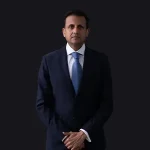
IN A CONVERSATION WITH PROPERTY TIME MAGAZINE’S BINESH BABU PANICKER, ANTON VIKTOROV, GENERAL MANAGER OF FUTURA EDGE, OUTLINES THE FIRM’S DEVELOPMENT PHILOSOPHY.
Futura Edge is entering Dubai with a strategy shaped by execution rather than expansion. The international construction and development firm, which has delivered projects in Ukraine, Spain, Georgia, Germany and The United Kingdom, is launching its UAE presence with two residential developments. This includes an ongoing project in Jumeirah Village Circle and an upcoming launch on Dubai Islands.
Futura Edge has over 15 years of experience in residential, commercial, and mixed-use projects. They operate as a construction-led developer, keeping control over delivery, costs, and quality. The company’s Dubai move marks a deliberate step into what its leaders see as the most regulated and transparent development market it has operated in to date.
In a conversation with PROPERTY TIME magazine’s Binesh Babu Panicker, Anton Viktorov, General Manager of Futura Edge, outlines the firm’s development philosophy, from balancing design ambition with discipline to prioritizing key relationships and fast commission payouts as a trust-building tool. Dubbed “the new kid in the block,” Anton Viktorov explains why Futura Edge is starting with residential projects in high-demand locations before expanding into other asset classes, and how the firm plans to compete as supply intensifies across the UAE residential market.
How do you categorize yourself as a developer? Are you mid-segment, affordable? And why focus on residential and not commercial projects?
Frankly, we don’t fit into a single category. We’ve delivered residential, commercial, office buildings, and shopping malls across different markets. In Dubai, however, we’re starting with residential. Residential projects are generally easier to deliver and sell, and regulations around commercial property can be more complex. From our experience, it’s the most practical way to enter a new market. From there, we’ll assess opportunities, and potentially move into the commercial sector later.
When you enter a new market, especially with more than 15 years of experience across global markets, how do you approach strategy? Do you come in aiming to compete, or to create your own space?
That’s exactly the strategy. We focus on creating our own space. If the product and service is good, we believe it will sell.
Can you tell us about your clientele, your sales approach, and your relationship with brokers?
Our clients come from all over the world. They include Indians, Brits, and Europeans from all over. There is no single dominant nationality. Most buyers are from abroad, which aligns with our marketing strategy. When it comes to sales campaigns claiming a project is “sold out,” we don’t do that. Our campaigns reflect genuine progress, and sales are strong.
Regarding brokers, we work with around 1,000, and one of our biggest advantages is that we pay commissions within 72 hours, a rarity in the market where some brokers wait six months at times. This has helped us build strong, trusting relationships, and our brokers appreciate the reliability. It’s one way we differentiate ourselves in an industry where delayed commissions are a common concern.
I recently interviewed an architect who spent 40 years designing buildings before becoming a developer for the first time. He said that when designs move from architect to developer, many ideas are often cut due to cost. On the development side, how do you approach that balance? Are you a “giver” or a “taker”?
It’s always a question of balancewhere you can save and where you shouldn’t. If you save too much, the product won’t be good. Our goal is to deliver a quality product. If we need to spend more to achieve that, we will spend more.
So that philosophy has stayed consistent over the years?
Yes. That’s been our philosophy all along.
With all the attention on Dubai, are you considering other UAE markets like Ras Al Khaimah or Abu Dhabi? Where do you plan to buy or start a new development?
We might continue investing in Dubai Islands. We’re not looking at cheap products. Our goal is always to find locations where we can command a premium for a quality development. But at the moment, we’re not looking at Ras Al Khaimah. Our focus remains on Dubai for now. Prices in RAK are high, but Dubai is also experiencing significant price growth, so it hasn’t drawn us away. Abu Dhabi is interesting-land is roughly half of Dubai’s, so it could be a good play. We’ll see.
But if someone abroad were looking to invest in the UAE, I wouldn’t give advice based solely on location. It depends on the product, the price, and where it’s situated. ROI depends on the project. Some Abu Dhabi developments might give 30 to 40%. In Dubai, you can find similar returns if you pick the right product. The key is identifying the right product in the right location at the right price. We can’t compare Abu Dhabi and Dubai as locations alone. They’re two distinct markets, and success comes from careful product selection rather than the city itself.
Are you considering joint ventures for any of your active or future projects, or will you develop them independently?
We’ll be doing it ourselves. We have the opportunity to develop projects independently, without the need for a joint venture.
Let’s pivot and talk about the legal side of the industry, especially post-2008. How do you view Dubai’s system for developers and buyers?
I think it’s one of the best markets. It’s well-regulated, and it is much easier to obtain permits and approvals here than in other countries we’ve worked in. Overall, it’s a well-regulated market for construction. The system protects developers, and buyers too. With escrow accounts, money is safe and protected, and it goes straight into construction. In that sense, the legal framework here is extremely strong and will continue to be that way.
There’s been a lot of discussion about potential oversupply in Dubai. From your perspective as a developer, do you see an oversupply situation emerging, and should buyers be concerned?
Quality is the main thing which brings buyers to Futura Edge. I think it will be our advantage as we deal with a potential oversupply. But hold on, a correction in general is good for any market, right? Because otherwise, it will keep on shooting up the prices and it becomes unaffordable for people in the long run.
We don’t actually think an oversupply is a real concern right now. The market is healthy, and not in a bubble like many claim. I’d even argue it still has strong growth potential. Maybe an actual oversupply or egregious prices could show up in three or four years, but not just yet.
As for buyers, they can trust the process. Dubai’s regulations, especially escrow accounts, protect their money. Funds go straight into construction, so buyers can be confident their project will be delivered. That’s what makes investing here secure.
Out of all the markets you’ve worked in, which one is better than Dubai?
I really cannot find a better market. Dubai is the best right now.